Σελίδες

Showing posts with label South America. Show all posts

Monday, May 25, 2015

Ushuaia, Argentina


This cozy Argentinean community, tucked into an inlet along the Beagle Canal, sits a mere 750 miles from Antarctica. That said, while Ushuaia may be set against a backdrop of snow-capped peaks, that’s where the comparison to the frozen continent ends. Instead, this colorful and naturally beautiful city is very much a tourist’s delight, a cosmopolitan haven at the end of the world where the summer sun runs to 18 hours a day and activities range from hiking, mountain biking and horseback riding to kayaking and sport fishing.
Given Ushuaia’s unique location at the southern end of Tierra del Fuego Island, visitors can choose to play hard in the great outdoors and still have time to take in some of the local flavor at a café, shop, gallery or restaurant—lamb and spider crabs are signature dishes here. The Ushuaia Maritime Museum, set in a former prison, is perhaps the city’s quirkiest cultural venue. It is home to an extensive collection of nautical history on the region exhibited in what was once a severe and desolate penal institution. 


Monday, May 4, 2015

Puerto Montt, Chile


The original settlement of Puerto Montt was named for the Chilean President at that time, Manuel Montt and dates back to 1853, when Vicente Perez Rosales and a group of  German immigrants decided to colonize the densely forested region around Lake Llanquihue. When train service arrived in the early 20th Century, the city really took off and became a popular stop for travelers between Magallanes and Chiloé. The city was ruined, and then rebuilt after the 1960 earthquake. Not surprisingly, given its nautical setting, Puerto Montt has recently grown into a major fishing and fish industry port known for its salmon. 


Wednesday, April 29, 2015

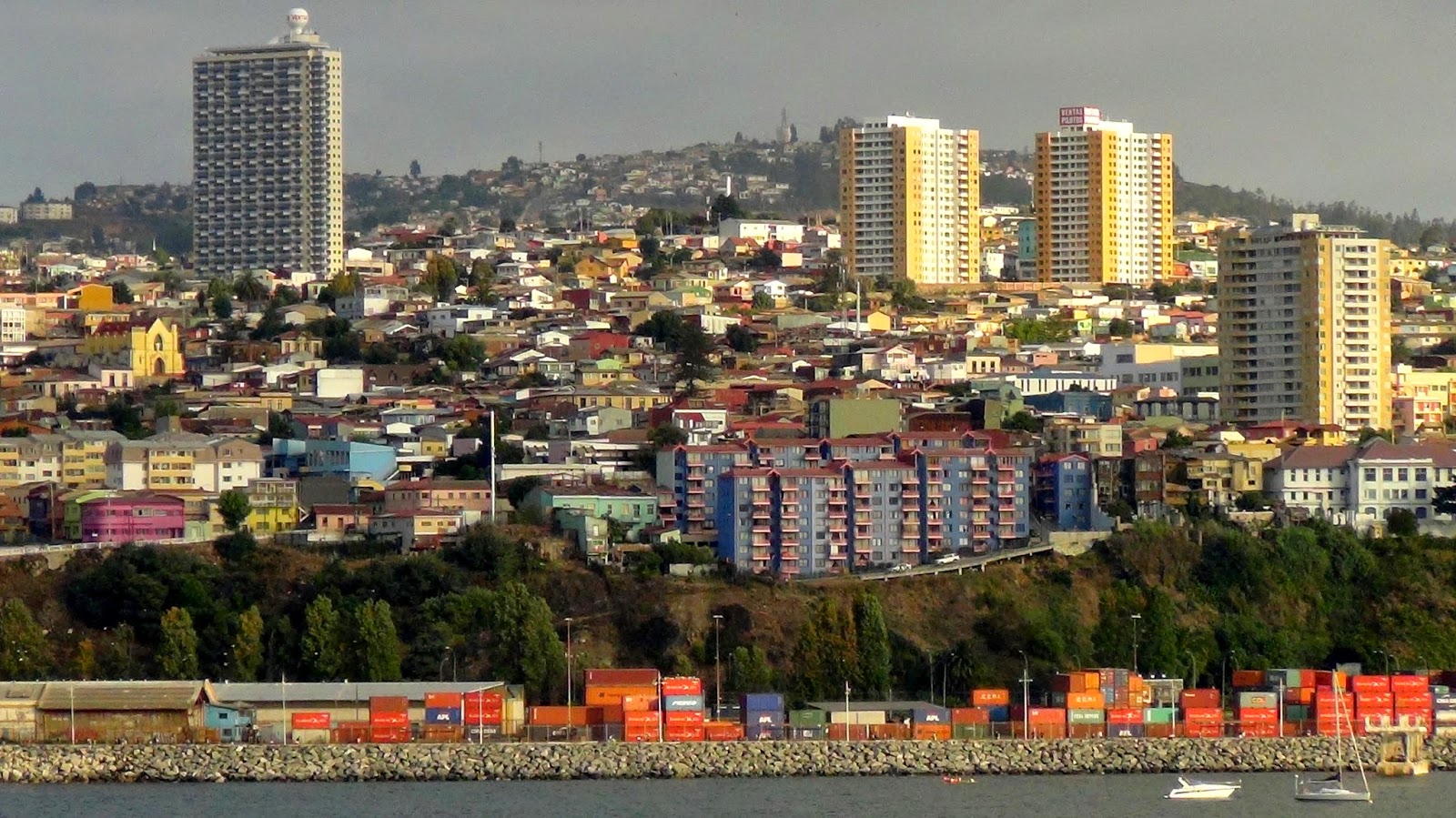
Valparaiso, Chile


Situated about 120km (72 miles) northwest of Santiago, Valparaiso is the second biggest city in Chile and the Capital of the Region.
In 2003 Valparaiso was declared a World Heritage Site, due to its historical importance, natural beauty, original architecture and layout.
You will find many funiculars, known as 'ascensores' throughout Valparaíso. These are a way for local people to be taken to and from their homes high up in the picturesque hillside neighborhoods. Some of the 'ascensores' where built as early as 1883. These are a must do when you visit the city as you will get to see some amazing views from them as you go up.
Muelle Prat (Prat Wharf) can be found at the foot of the Plaza Sotomayor, the main square of Valparaíso. Muelle Prat is the only wharf where the public can closely watch the loading and unloading of the ships from a safe distance (if that's your type of thing). You will find a typical handicrafts market at this wharf and boat trips around the harbor can also be taken from here.

Wednesday, April 1, 2015

Arica, Chile

Arica is in the Northern Chile. It is a seaside resort town (170,000 pop): quiet, relaxed, safe, with several nice beaches and sun virtually every day of the year. The city of eternal spring is the northern gateway to Peru and Bolivia.
Arica spreads out at the foot of El Morro Hill, the site of a major battle of the Peruvian War (1879-83). Today, the hill is a national historic monument, complete with an open-air museum. The summit of El Morro affords excellent panoramic views, which survey the city, the ocean, and even the distant Atacama. Among adventure travelers, the city is best known as the starting point for excursions into the Atacama Desert. 

The Museo Arqueologicò San Miguel de Azapa, located a short distance out of town, gives an excellent introduction to the history of the area. Among its most fascinating exhibits are a collection of Incan mummies, whose bodies were perfectly preserved in the extraordinarily arid sands of the forbidding Atacama.
Also of interest in Arica is the San Marcos de Arica church, designed by the famed tower-builder Gustav Eiffel. 


Monday, March 23, 2015

Lima, Peru


Lima is the capital of Peru and its largest city.
The modern city is a curious mix of the modern mega city with some 'islands of modernity', large but orderly slum areas and colonial architecture in the city center.
Metropolitan Lima is a metropolis of almost 8.5 million people. Many of these people have migrated from the Andes mountains to find work in Lima, without success. For this reason, there is widespread poverty in the city center and in the peripheral areas. If you fly into Lima, the first thing you see upon leaving the airport is these types of poor neighborhoods between the airport and Lima's historic center.
Lima is built upon a valley surrounded by an extremely arid desert. In the summer, the weather is usually beautiful, very warm and sunny, sometimes with rains around January. In the winter, the city is overcast and rainy for days at a time. The rain in the wintertime doesn't fall hard, but it gets everything wet. Temperature also falls to around 7-12 C (45-55 F), which seems chillier when combined with the general dampness.


Monday, March 16, 2015

Salaverry (Trujillo), Peru


The Peruvian port of Salaverry leads the way to Trujillo, the nation’s second-largest city,  situated before the Andean foothills. Salaverry is located 15 kilometers (9.3 miles), approximately 30 minute-drive southeast of Trujillo city.

Trujillo is a city of rich colonial architecture and very important archaeological center of the pre-Inca era. Today much of its colonial charm is still retained in its old churches, balconied homes and courtyards with overhanging flowering baskets. Like most Peruvian cities, the Plaza de Armas is surrounded by the cathedral and city hall. Numerous colonial mansions have been preserved in the old city and are open to visitors. The fronts of many of these buildings have distinctive wrought-iron grillwork and are painted in pastel colors.

Marinera is a coastal dance of Peru. Marinera is a graceful and romantic couple's dance that uses handkerchiefs as props. The dance is an elegant and stylized reenactment of a courtship, and it shows a blend of the different cultures of Peru. The dance itself has gained a lot of recognition and is one of the most popular traditional dances of Peru. Ever since the 1960s, during the month of January, in the city of Trujillo, declared national capital of this dance by law N° 24.447, January 24, in 1986 and a National Contest of Marinera Nortena is held. In 2012, the Congress of the Peruvian Republic declared October 7 as Marinera Day in Trujillo City, which is celebrated with a parade and dance expressions.

Monday, March 9, 2015

Cartagena, Colombia


Cartagena, also known as Cartagena de Indias (Cartagena of the West Indies) was founded in 1533 by Don Pedro de Heredia, and named after the port of Cartagena in Spain’s Murcia region. It was a major center of early Spanish settlement in the Americas and continues to be an economic hub as well as a popular tourist destination. Today the city looks more like a modern metropolis than one of the oldest cities of the New World. The Port, Fortresses and Monuments of Cartagena have been on UNESCO’s World Heritage List since 1984.
History is present throughout the city in its walls, colonial architecture, and in numerous impressive military and religious monuments. These all come together harmoniously with clear-water beaches, exotic nearby islands, and lively bars, cafés, restaurants and night clubs. Surrounded by a ring of massive fortress walls built by the Spanish starting in 1586, the Old City is a delightful enclave, filled with shops, restaurants, and historically significant old structures which make for a fascinating walking tour. Across the lagoon is the enormous Fortress of San Felipe, largest Spanish fort in the New World. High atop San Lazaro Hill, the fortress provides a grand view of the city. 


Thursday, December 11, 2014

Manta, Ecuador

Manta is Ecuador’s fifth-largest city and is often ranked first among the world’s sun and sand set as it is home to some of South America’s most beautiful beaches: Barbasquillo, Santa Marianita and San Lorenzo among them. That said, it’s no surprise to find that nautical activities abound here, from waterskiing and deep-sea fishing to kite-boarding and wind surfing, a sport serious enough to draw the South American championships to the city recently.
Manta derives its name from the ancient Mantamanian Indians who long ago populated the region. Visitors needn’t travel far from Manta to explore local towns rich in culture and craftwork, from Montecristi to La Pila, just outside of Manta, where local art pottery is a favorite take-home among visitors. 

Wednesday, July 16, 2014

Reporto

As a child I remember myself dreaming of travels to the most distant parts of the world. Growing up, nothing seemed that this dream could become reality. However, I knew that this , one way or another would happen. Maybe because the… "Never is too late for anything", is an attitude for me.   Since travels were limited and always in line with my job leave, the only travel left was the mental journey. The National Geographic magazine adorn at least four double shelves in my library since the collection was started by the first issue was released in Greece until today. I traveled with them in remote places of the world; I have met specific cultures and have seen very close the biggest, smallest, strangest animals ... How far you can travel by dreaming...

 Over the years, another great love was growing slowly but steadily. My love for the sea. From summer to summer and weekend to weekend, the sea came to be almost unique destination, solid escape from routine. It was the place where I could reach the closest point to my real self. Near the sea I become a better person. Near the sea I can see everything more optimistic. Near the sea I can create. Near the sea I dream like nowhere else...

 “Conspiring universe”. This is the only way I can explain how my life has changed so drastically and now I can travel often and getting know what all those years I was dreaming of, through the sea routes. Traveling is no longer just a holiday but part of my daily life. A beautiful daily round full of all the shades of blue ocean and sky, smelling the sea and almost tasting the salt.

 These travels are not tourist ones. Besides, I never consider myself as a tourist. I didn’t want just to visit different places. I wanted to see the world, to see different things, neighborhoods, people, cultures, habits, commonness ... Of course it is also interesting to visit popular places, to get a picture with them and learn firsthand their history. Personally, I’m more interested in the diversity of what we already know. What I mean is, if someone visits Greece, can see some of the most beautiful places on the planet. Our islands, our archaeological sites, our history and our cities. Who would not be thrilled by a walk in Plaka, a performance at the Herodion or move around in Thisio and get on a wonderful ramble to the Acropolis? Who can deny that if you visited Greek islands like Santorini, Mykonos, Rhodes will be filled with images that will remember all his life?

 But that's not all. Honestly, living in Greece in the 21st century, what a tourist sees does not representing correctly the original picture of the country.
The same of course applies to all countries in the world. There are always places for tourists and somewhere hidden behind them is the commonness of people, which, personally, I find much more interesting...

 In these few years of traveling, I have filled with videos and photos many hard drives and countless memory cards. I knew at some point I would like to talk about all of them. This is my archive, and I consider it as granted.
 From now on, with my camera on hand, we will travel all together.

Bon Voyage